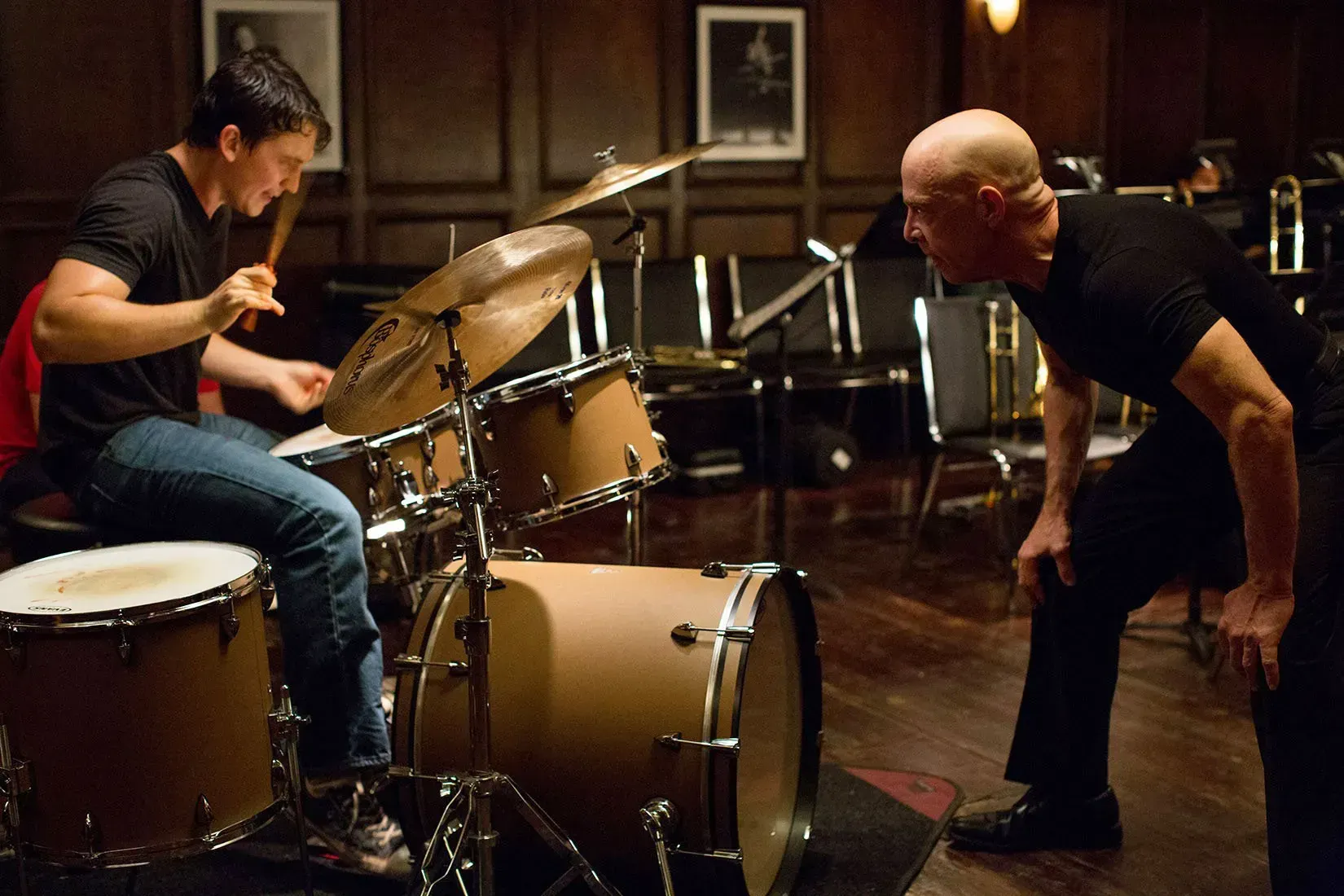
I recently watched the movie Whiplash (d. Damien Chazelle) again at Filmhouse as part of their "Music in film" series. The last time I had seen this film was back in 2016, at my grandma's house (RIP granny).
Watching this masterpiece of a tragedy definitely brought back some nostalgia, largely because I used to be a band kid (on trombone no less) back in secondary school, and also because I am now somewhat integrated into the local music scene in Singapore as a bassist (world's coolest instrument).
Back then I remember feeling largely traumatised by the way band conductor Terrence Fletcher (played by J.K. Simmons the GOAT) treated Andrew Neiman (drum protagonist played by Miles Teller), and hyperfocusing on the over-the-top effort from Neiman to obtain greatness. They mirrored how my old band conductor would mald and rage at us for being out of tune, or failing to play notes correctly. I remember his words, "music is the only profession that doesn't tolerate imperfection" - an eerie parallel to Fletcher's own worldview.
This year, as I sat in the comfy seat at Golden Mile, I felt more analytical than ever, partially due to already knowing what happens next, but also due to having experienced band life in a semi-professional capacity.
With my new perspective, grappling with the core concept of "greatness requiring great sacrifice" (or in Fletcher's case, extreme sacrifice) became a lot more complicated than the linear correlation of "working so hard that it becomes statistically impossible to fail"(paraphrasing Alex Hormozi).
In the movie, Neiman ends up sacrificing his love interest, his mental health, his physical condition (bleeding hands and getting hit by a truck) and even his place in the conservatory, before returning to the stage to get set up by Fletcher (therefore nearly sacrificing his reputation), only to attain "greatness" via a magnificent drum solo based off Buddy Rich's flamboyant chops.
Of course, what Neiman really did was to devote all his focus and attention on the craft of drumming, in the same way an obsessed savant would - after all, many gurus and hustle grifters these days would definitely encourage single-minded pursuit of greatness, discarding all else. And this doctrine has definitely been hammered home since the days of the protestant work ethic .
Therefore, on first glance (aka 2016 me), I was inclined to agree with the search for greatness (I still do to some extent, but with temperance) requiring some amount of effort and sacrifice. Yet the second viewing left me with some newfound thought.
My new take on this classic cult film, was that the autotelic drive to love music was replaced by a desire to sacrifice everything for greatness. Therefore, music becomes a vehicle for both Neiman and Fletcher to achieve their vision of greatness.
Even as the movie starts we can already see that Neiman was driven and single minded from the very beginning (his childhood). He idolises Buddy Rich, practices diligently, listens to drums on the commute, and is generally positively motivated. Neiman becomes the perfect vessel for Fletcher to manipulate.
Fletcher's entire shtick isn't trying to teach every student equally well - as he said it himself, his main mission is to create the next Charlie Parker, and he does so by utilising the various psychological tools he has in his arsenal. Based on his viewpoint, not everyone has it in them to become great. "Good job" are the two worst things you can say to someone who desires growth, he says in the bar scene (they made him play the most average piano solo of all time in that scene which is quite hilarious in my opinion).
The validation-seeking, result-driven Neiman was thus abused and molded into a Fletcher pet project, almost like how some parents use their children as vessels to live out their own dreams vicariously. I found this again quite a fun literary juxtaposition between Neiman's actual dad who represents familliarity, unconditional love and safety versus Fletcher the susbitute dad(dy) who represents danger, risk taking and achievement-based self flagellation (this is getting a bit BDSM adjacent).
The the lack of women in the movie seems intentional. Apart from Neiman's love interest Nicole (played by Melissa Benoist), the lawyer, and his aunt who appears briefly, there are no other female characters (notably, Fletcher harps on about Neiman's mom leaving his family as a means of manipulating him). Even the female saxophonist in the first Fletcher scene is reduced to a sexist character trope. It seems like toxic masculinity, competition and aggression were pivotal to the atmosphere in the film, and Chazelle achieved that by simply removing any trace amounts of femininity (and even female characters only exist in relation to male characters), therefore failing the Bechdel Test. This machisimo was also explored in Adam Neely's video, where he considers Whiplash to be more of a sports movie than a jazz movie.
Despite the big questions the movie was asking, two scenes stole the show for me on the second watch. The first was the family dinner, where Neiman's relatives are over for dinner with his dad, and they start doing the stereotypical asian thing of comparing their kids' life paths (one was a promising academic and the other a football varsity jock) and Neiman has to defend his chosen life path (potential to be a jazz great) in the face of judgemental comparison from his peers, eventually culminating in one of the best one-liners from the show:
Travis: "Come play with us."
Neiman : "Four words you will never hear from the NFL."
(feel the burn)
The parallels to peer comparison in Singapore, the measurement of life through an achievement lens, and the fact that even Neiman's dad had doubts about him making it into Lincoln Center (prestigious jazz organisation) hit pretty close to home (thankfully my parents weren't the comparative kind bless them), and highlighted the social pressures on people who choose unconventional paths with non-obvious payoffs. In that moment, Neiman stood up for those who chose to embark on unconventional paths (albeit in a twisted way as he psychopathically discarded the need for friends) in the face of famillial pressure.
There was also some surprising character development with bits of Fletcher having rubbed off on Neiman during this scene, with the witty clapback and disdain for non-specialised pathseekers (Neiman uses Fletcher's Charlie Parker anecdote to dispel the need for friendship) being small literary devices used to foreshadow Fletcher's worldview creeping in.
The second scene that got me was the final concert scene, where Fletcher deliberately misled Neiman into rehearsing the incorrect setlist for the Nassau band, embarrassing him in front of Lincoln Center judges. As Neiman walks off the stage in humiliation, his dad goes over to him and comforts him, saying "let's go", offering Neiman a chance to walk away from the path of greatness (and traumatic abuse) forever. At this point, a pivotal question is raised - should one forsake their own family in the pursuit of greatness?
Neiman simply hugs his dad and walks back onstage to deliver the signature performance of Duke Ellington's Caravan (go listen now if you haven't), implying that he was "saying goodbye" to his dad and devoting his life to jazz. This is all but confirmed near the end of the scrumptious solo, where Fletcher locks eyes with Neiman (almost in a pseudo romantic manner), which appears to be the first time he actually acknowledged him on the same level (in contrast to the multiple abusive scoldings and deception in earlier scenes). Therefore, we can safely say that Neiman attained his goal (at a very high cost indeed).
As a musician, I can see how this narrative would appeal to an audience, after all it follows both the structure of a bildungsroman and a tragedy, giving you two for the price of one. It's entertaining, the emotional tension and conflict keep you on your toes. However, the competitive band scene is quite divorced from the reality that working musicians experience. It is much more mundane, and isn't as linear as the movie makes it out to be.
The role of human relationships, which Fletcher (and by extension), Neiman discard as secondary to pure musical talent and artistry (in a grindy way) is actually more essential to landing gigs or show offers as a working musician.
I hereby invoke the Gig Triangle Principle, which states that a musician requires at least 2 out of 3 elements of the triangle - Good Money (Pay), Good Music (Either you love the music or its of a high enough quality), and Good Company/Mates/Hang (The people aren't a total pain to be around) - before accepting a gig. This dynamic can be inverted into a "Do we hire this musician?" chart, and Neiman would only excel in the technical department but not the social one.
Based on my own experience in the local music scene, in a multitude of genres, I would put relationships on a higher tier than the other 2 factors, simply because it is an automatic disqualifier (the others are more iffy and can be negotiated). Thus from a practical point of view, sacrificing potential social multipliers for grinding technicals seems to be a self-inflicted gunshot wound for Neiman.
This is true even in Jazz, as chops (technical skill) are important but being a nice person is what gets you the gig. My working theory is quite simple. At the level of professionals, margins are blurred and almost everyone is on a comparable level in terms of skill and technique, and pay is around the same (bar megastars and exceptions). Therefore the social aspect becomes more of a disqualifier. Sometimes all you want is to play a fucking good gig with your friends for $200 and go eat supper afterwards.
In the show, Neiman has not yet attained megastar or prodigy status, thus his diva tantrums and singleminded, corrupted devotion to a false ideal leads him down a destructive path. There is no love for his fellow musician colleagues, they are merely obstacles in his path. The inclusion of a prodigious trumpeter that Fletcher drove to suicide also makes it pretty clear - Fletcher's methods are abusive, and even if they lead to moments of genius, those moments are temporary and come with traumatic baggage. There is no love for the people Fletcher molds, only singular focus for the end result.
The irony of it all is that there is no love for music that I could see, not from Neiman, from Fletcher, any of the conservatory students or even the soundtrack (lmao). I think that the intrinsic love of the art form and beauty of music (especially Jazz) was lost in trying to tell a story about greatness and sacrifice. Perhaps in an ironic twist, Fletcher and Neiman weren't sacrificing everything else for music, they were sacrificing music for greatness.
